Connect people, processes, projects, data, existing systems and AI — working together on one platform. We design how businesses work, and build the platform to orchestrate it.
A business is home to many systems, processes and teams — each good at its own job, but working together in harmony doesn't happen by itself. BusinessChord governs when, in what order, by which rule, with which authority and which data people, processes and the systems you already use work together: What should happen next? Who should act? What awaits approval? What is delayed? And thanks to its modern API it can integrate with every product in your business — it doesn't replace your existing systems; it makes them part of the same orchestra.
Process behavior is data: stages, approvals, forms and rules are defined on screen. Algorithms like "escalate approval above this limit" are built into the engine — you simply choose.
Changing a process creates a new version; open cases keep flowing on their own version. "The rule changed and broke work in flight" is architecturally impossible.
Authority and approval chains attach to positions, not people. When someone leaves and another arrives, processes keep working — nothing to update by hand.
Cases awaiting your approval, work on your plate, tickets assigned to you — one badge, one screen. Who holds what is always clear.
"Remind 3 days before the deadline", "escalate tickets unassigned for 24 hours" — set the rule, the engine enforces it. Notifications arrive in-app and by email.
Role and permission based, department scoped, fully audited. Sensitive fields like salary are guarded by separate permissions — no "managers see everything" assumption.
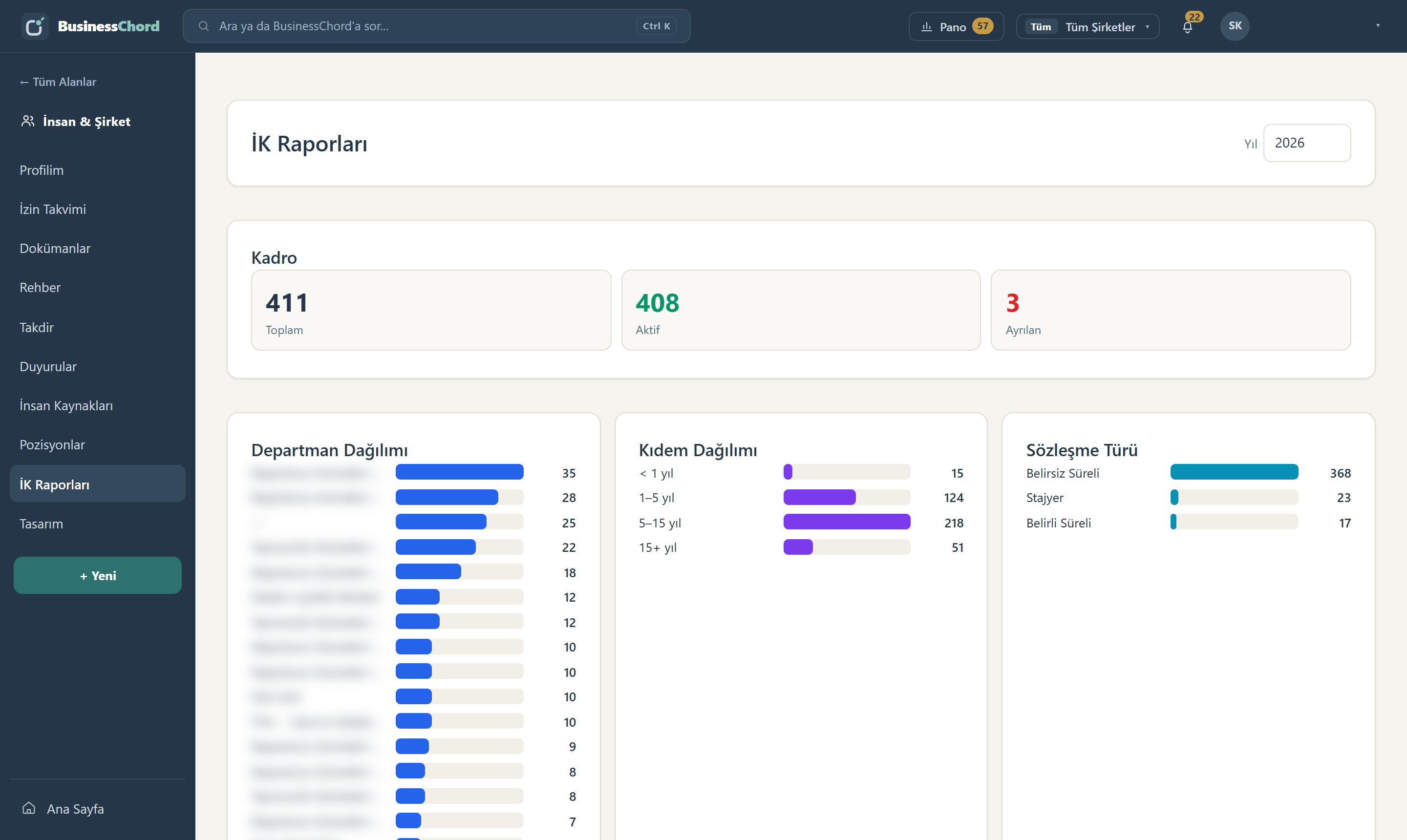
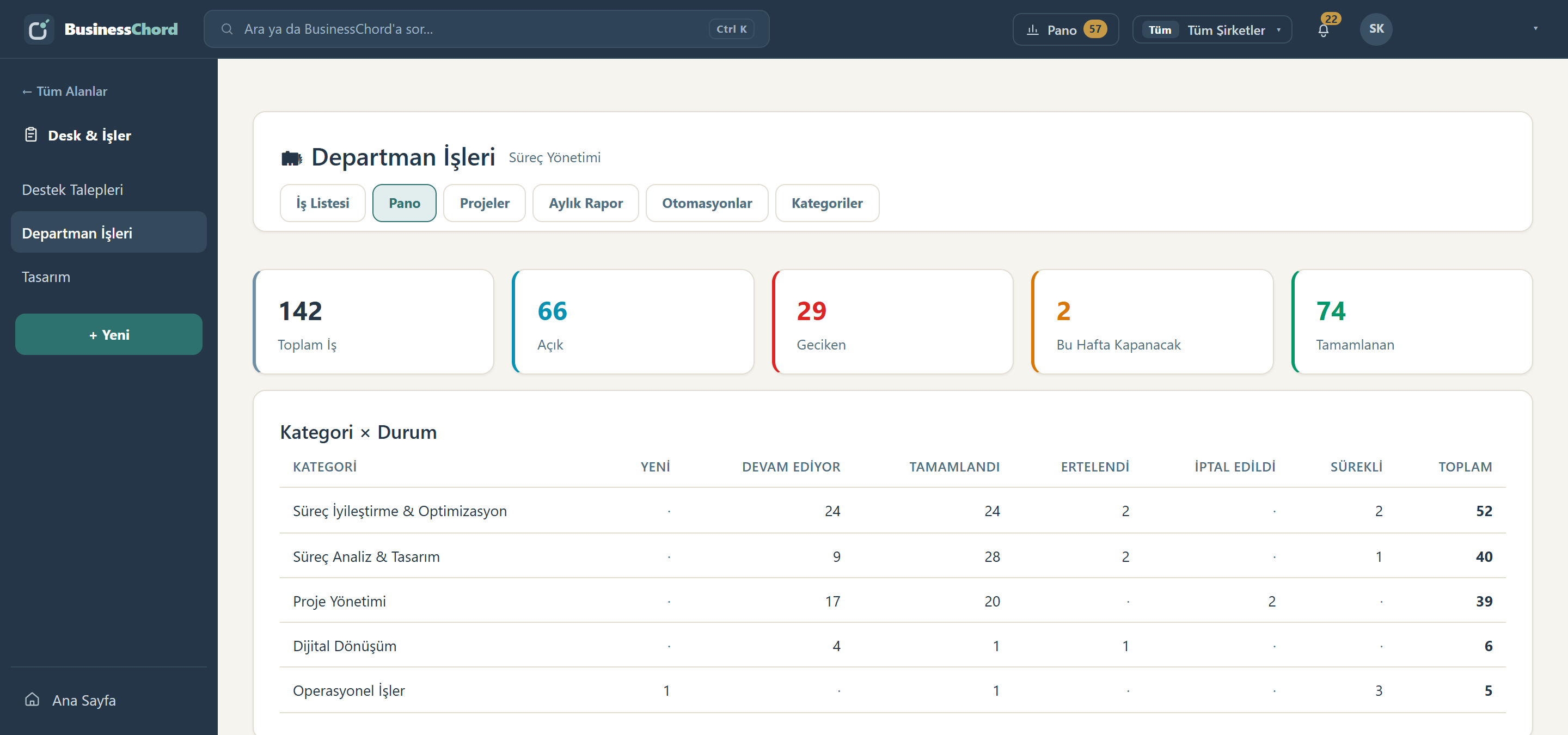
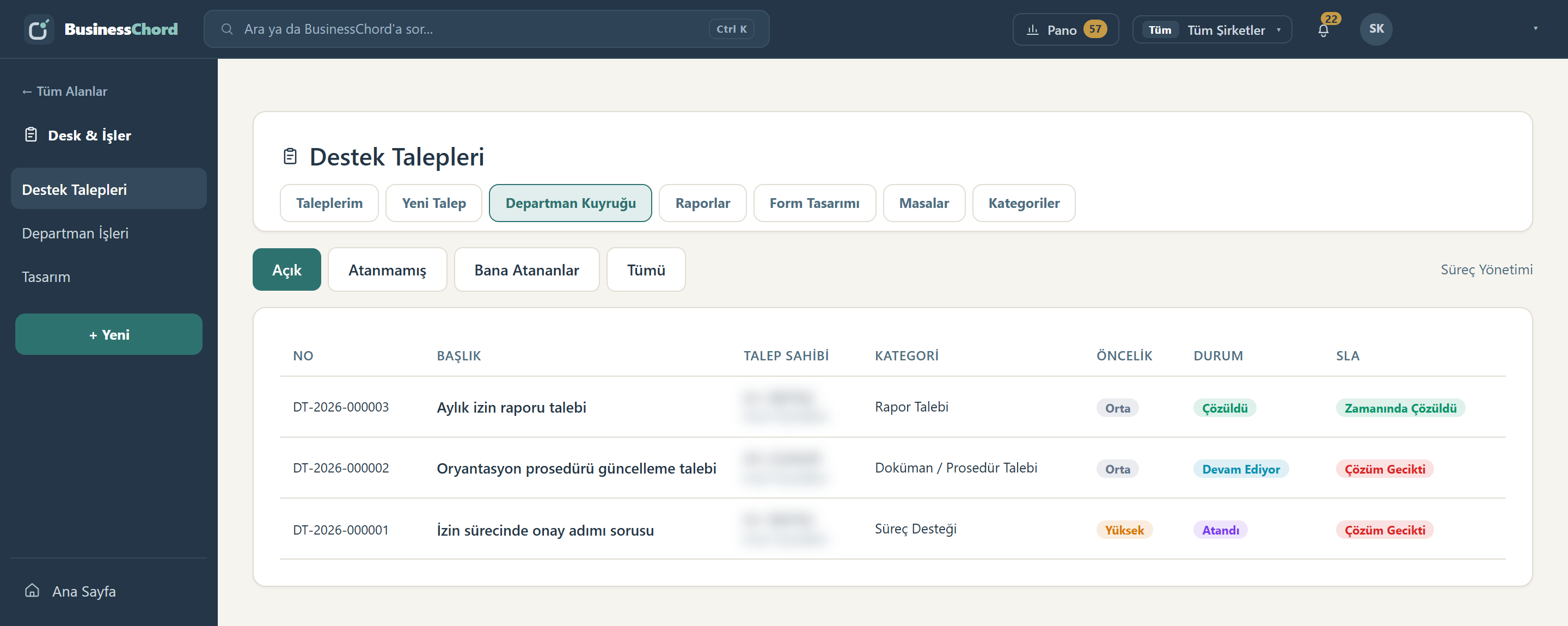
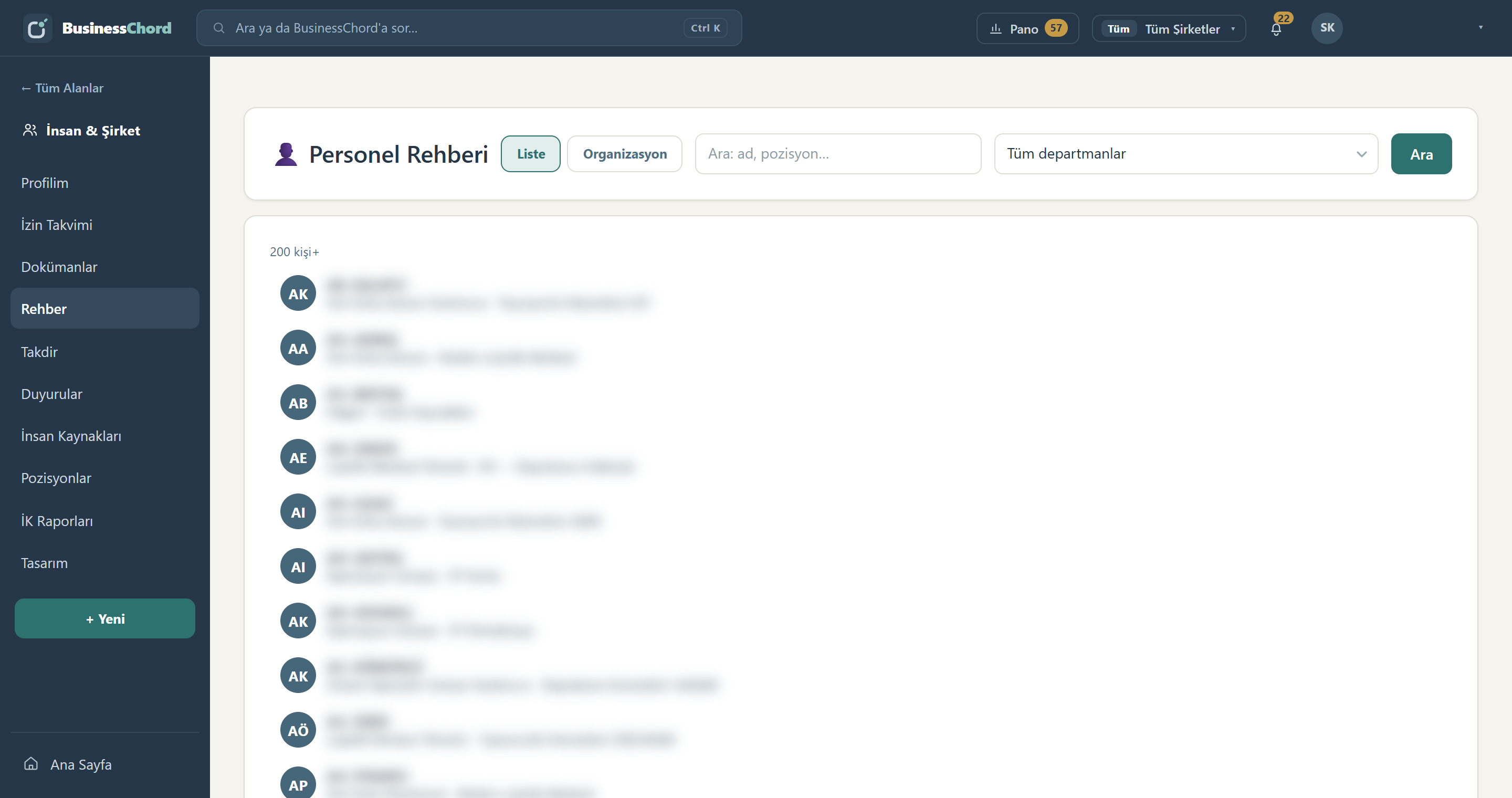
These screenshots come from a running installation. Employee names, unit names and job titles are blurred; the figures and statuses are untouched.
BusinessChord doesn't make the parts of a business the same. It makes them work together — in the right relationship, order, context and timing. The five letters in our name are the shared philosophy of both the platform and the consulting practice.
Meaningful connections between people, processes, roles, data, projects, systems and AI. The connection it builds is wider than technical integration; it covers organizational, permission, decision and task relationships.
Different functions work together without being forced into one type: without conflict, complementing each other, toward a shared goal.
The right action at the right time, in the right order, with the right authority: workflow + rules + approvals + integrations + automation + AI.
Every business has a rhythm: a request arrives, a decision is made, work gets done, results are measured, a new request arrives. That cycle becomes visible, measurable and manageable.
Businesses change constantly: people, roles, processes and priorities. The structure adapts without losing continuity — evolving without descending into chaos.
"What happened?" — transactions, records, balances. Necessary, but it doesn't run the work on its own.
"What should happen next? Who should act? Which rule applies? What needs approval? Which system should respond? What should AI do?"
Real companies run four kinds of work — most software forces you into one. BusinessChord keeps all four distinct yet connected on one platform: a ticket becomes a work item, work rolls up to a project, a process updates the record.
Flow work. Purchasing, advances, leave, onboarding… Staged, approved, versioned. Who approves and which document is required — all defined.
Record work. Long-running department workload: categorized, deadlined, dashboarded. The system computes deadline status.
Queue work. Cross-department helpdesk: SLA targets, a single timeline, attachments. If a ticket grows, one click turns it into work.
Handover work. Multi-department projects: unit-by-unit handover chains, accept/reject flow, live progress.
The modules are different instruments of one orchestrated business. All of them run on the same identity, the same organization, the same permission model and the same process engine.
Process engine + visual designer: workflow, forms, approvals, business rules, limits, versioning, printable forms and automation · unified Pending · permissions · setup wizard and bulk CSV import · in-app guides.
Organization, positions and authority relationships · employee card (HR file, dependents, qualifications, protected salary field) · asset management · onboarding and offboarding processes — the process completes and the record opens/closes itself · self-service "My File" · leave calendar and balance ledger · company portal with announcements, document library, people directory and calendar.
Support tickets: department queue, SLA, internal notes, attachments · department work registry with your own category taxonomy · dashboards: category×status, overdue, upcoming, workload per person · work↔ticket bridge · multi-department projects and handover chains · automation rules + email channel.
Customer, opportunity, sales and interaction processes · sales steps orchestrated by the same engine: quote approvals, the flow toward a contract, a customer request becoming a process · customer history on a single timeline.
KPIs, dashboards, process analytics and management visibility — the answer to "how well is it working?". Deadline and SLA status is computed automatically; the ledger is the truth, summaries exist for speed.
Natural-language questions, file summaries, filling forms from documents, request routing and suggestions while designing processes. Every suggestion is previewed — nothing changes until you Approve / Edit / Cancel, and you choose which processes' content may go to the AI.
New instruments on the roadmap: BusinessChord Contracts (contract lifecycle) and BusinessChord Procurement (need-to-order purchasing orchestration).
Software only accelerates a badly designed way of working. That is why BusinessChord is two structures in one: Consulting, which designs the company's Business Operating Model, and the Platform, which runs that model in daily operations. Both share the same philosophy.
Designing how the business works: functions, processes, roles, authorities and decision mechanisms.
Process discovery, process architecture, standardization, simplification, SOP and policy design.
OPEX, Lean, DMAIC, root-cause analysis, efficiency, waste reduction and continuous improvement.
Building the right business model and working logic before a process is ever moved into software.
KPI design, process performance, management reporting and decision-support structures.
Applying AI to processes, operations and decision mechanisms — starting from the right place.
Consulting designs how the business should work: processes, roles, rules, decision points.
The Platform runs the designed model in daily operations: flows, approvals, automation.
Insight measures how well it works: KPIs, process analytics, delay and workload visibility.
Measurement feeds the next design — and the cycle starts again. A process is drawn again as the business changes; it evolves with it.
BusinessChord doesn't require an army of consultants. Setup is part of the product — three steps and you're live, with everything in your own hands afterwards.
An empty system is set up with three questions: company name, first department, system administrator. You are inside with full rights in minutes.
Fill the ready-made template: departments, positions, titles, people and manager links in one file — preview first, then apply.
Define your first process in the visual designer, or start instantly with built-ins (leave, purchasing, on/offboarding). The in-app guide stays with you at every step.
There are two user classes: a Full User runs processes, resolves work and tickets, and manages. A Portal User uses self-service screens, opens tickets and enjoys the intranet — every full user includes 3 portal users free. Processes, forms and automations are unlimited.
| Plan | Full user / month | Scope |
|---|---|---|
| StarterTeams starting with one department or a pilot | $12minimum 25 full users | All of Process, plus one additional instrument (People, Desk & Projects or CRM). Three portal users per full user. Standard support. |
| EnterpriseOrganizations building a company-wide digital workplace | $10minimum 100 full users | Process and every instrument, unlimited portal users, on-premise deployment, the "Out of the Box" setup package, priority support SLA. |
| Enterprise+Multi-company structures, specific requirements | Customscoped to your requirements | Everything in Enterprise, plus holding / multi-company structure, enterprise system and directory integrations (SSO included), per-day process consulting, dedicated support and roadmap access. |
Fixed-price setup package: environment install, staff import via wizard + CSV, co-designing your first 3 processes, admin training. The industry charges 15–20% of first-year value; BusinessChord ~10%.
Per-day when needed: process analysis and design, data migration, custom reports. Optional; your own team can do it with the designer and guides.
Standard support is included. Priority SLA (target response times, release priority) adds 10–15% of the annual fee. Updates are part of the subscription.
Prices are indicative for annual billing; the final quote depends on user count, module selection and setup scope. For organizations preferring a perpetual license, a license + 20%/year maintenance model is also available.
BusinessChord was born inside a real operation. In a logistics organization with hundreds of users, the entire daily workflow — from purchasing to leave, onboarding to support tickets — was taken out of spreadsheets, email threads and disconnected tools and orchestrated on a single platform.
That is why every screen in BusinessChord answers a lived need: the leave ledger never loses a day, the handover chain ends the "who has this?" question, and the setup wizard gets you running without waiting for consultants. We use the product ourselves every day — the toughest test there is.
Algorithms live in the engine; you choose which strategy runs with which parameters. A new process = new configuration.
Processes touch records: onboarding completes and the employee card opens; offboarding completes and it closes. Data keeps itself current.
Every action leaves a trace: who, when, and why. The ledger is the truth; summaries exist for speed.
From setup to categories, process design to permissions — everything on screen, with your own team. Consulting is optional.
No. The systems you use keep managing your transactions and records. BusinessChord orchestrates when, in what order, and by which rule and authority these instruments and your people work together: "What should happen next, and who should act?" It replaces nothing; it can integrate with every product in your business and makes them all part of the same harmony.
BusinessChord is deployed on-premise: the database and files stay on your servers, inside your network. That is the simplest ground for GDPR/KVKK obligations. AI features are optional: if you turn them on, you decide, process by process, whether its content may be sent to the model; for a closed process the system never sends its content to the model; case summaries and fill-from-document are switched off there. The whole platform works without AI switched on. A cloud option is on our roadmap for organizations that request it.
Yes — for the technical install and staff import. The wizard opens the system with three questions; the CSV template loads your organization and people in one file (preview first, then apply). Enriching your processes is ongoing work — with the built-in processes you are productive on day one.
No. The visual designer defines stages, approval chains, forms and rules on screen. The in-app Process Design Guide explains every concept with examples. If you like, we co-design your first processes in the "Out-of-the-Box" package.
Yes — BusinessChord is built on a modern API and can integrate with every product in your business; enterprise system and directory integrations (including SSO) are scoped under Enterprise. It also runs perfectly standalone — there are no prerequisites to start independent.
No. Processes, forms and automations are unlimited — you pay only per full user. Employees who open tickets and use self-service are portal users and largely free; nothing in the pricing stops the system from reaching the whole company.
Yes. The annual subscription covers version updates, fixes and standard support. For organizations on the perpetual license model, updates come with the annual maintenance fee.
Fill in the form; see BusinessChord on your own scenarios in a 30-minute demo. We reply the same day.